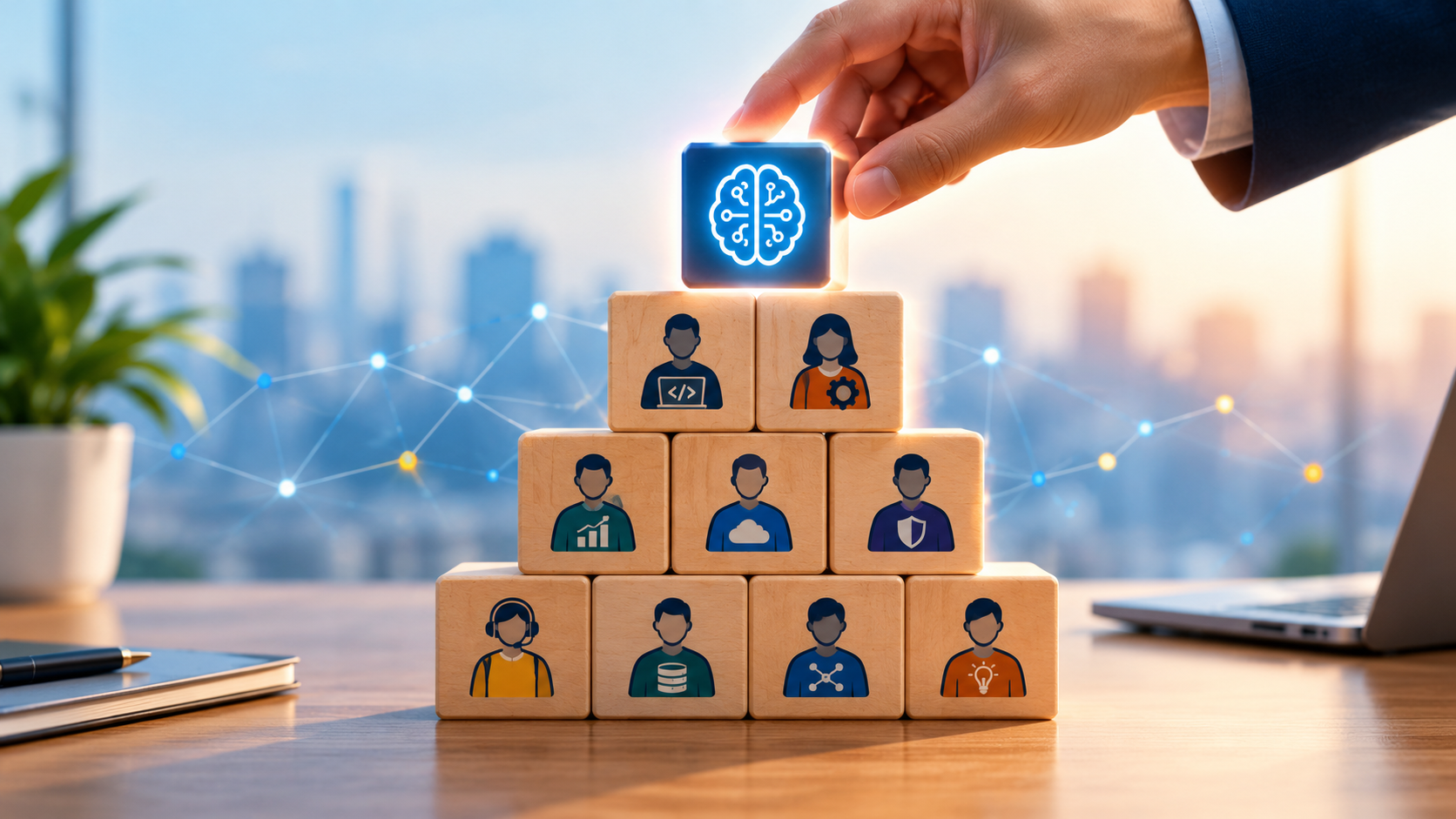
As AI transitions from a mere experimental solution to becoming an integral part of how organisations resolve problems, make decisions, and best serve customers, we are compelled to ask: what expertise does an AI initiative actually need to succeed?
Consider the example of a bank introducing an AI-powered chatbot designed for customer support: while at first glance it may appear to be a technology project — from building the chatbot, to connecting it with the right information, and then presenting it to the customers — there is much more to it that needs to be correctly completed, from ensuring its structure and reliability, to ensuring the accuracy of answers within the specific business context, from appropriate controls regulating its access and what features it can use, to considering how people and processes around it must adapt, upon deployment of the bot. This suggests that a wider set of expertise is key to ensuring that the AI works.
AI as the Visible Layer
AI tends to be the most visible part of an initiative. It enables the chatbot to understand questions submitted and to generate responses accordingly. However, this capability is built upon several layers which play the quintessential role of determining whether said responses can be trusted and used, answering questions such as: where the information comes from, whether it’s accurate and updated, how the chatbot connects with the systems that hold it, the information that it’s able to access, and how it fits into the existing customer service process.
The Expertise that’s Often Overlooked
While it varies from case to case, broadly speaking, most AI initiatives require capabilities beyond the AI itself.
Data and information is one of the primary layers that require attention. The aforementioned AI initiatives depend on AI architecture, engineering, governance, and analytics. The prerogative is to ensure that the right information can be accessed, understood, connected, and appropriately used. For the chatbot, this may include working across multiple information sources and systems to establish what information the solution can rely on and how this information flows into that experience.
Secondly, technical AI expertise remains central. Key experts include solution architects, ML and GenAI specialists and MLOps professionals; with them comes the capabilities required to design and implement the solution. However, the solution should work within the frameworks of the organisation, its systems and business environment.
The next aspect involves enterprise systems and integration. Here, ERP and CRM platforms, APIs, cloud infrastructure and legacy systems, form an essential part of the environment in which an AI system needs to operate. Meanwhile, integration expertise ensures the capability is connected to the aforementioned environment, ensuring that it works well within its context, rather than as a standalone tool.
Additionally, security matters such as privacy, cybersecurity, AI governance and regulatory requirements impact what information the AI can access and its response when a customer interaction needs to move beyond the AI system. Through governance and risk compliance expertise, it is possible to establish these boundaries along with the accompanying controls required.
Lastly, as AI changes how people work, it may necessitate redesigning of processes, shifting responsibilities, and the adoption of new ways of working. Therefore, transformation and change expertise helps organisations integrate this new capability into the business’ practices.
Quintessential Context
The right combination of expertise, as described above, depends heavily on the exact problem being solved and the context in which it exists. For example, while a predictive maintenance project within manufacturing may require operational and equipment expertise, a BFSI requirement may focus more on regulatory and risk expertise.
Why Independent Expertise Matters
Given that AI initiatives tend to be project-based, within their own contexts, or part of a broader transformation programme, the organisation’s expertise requirement may evolve between stages. For instance, while a business may need deep data expertise initially to lay the foundation, or specialised business functional expertise to resolve any problems that arise when moving into adoption, these requirements may not be permanent.
Independent experts can provide that depth of expertise when it matters most. This allows an organisation to bring in specific capabilities without having to permanently integrate every requirement into the organisation. Therefore, rather than asking whom we need to build the AI, it may be apt to reframe the question and ask what expertise the initiative needs to succeed.
The Next Advantage is Access to Expertise
As AI capabilities become increasingly accessible, the difficulty arises in applying them effectively within the complex structures of an organisation, from its systems and processes to its context. This makes access to the right expertise all the more important.
This is where IndusGuru can help.
IndusGuru connects firms with a curated network of independent consultants, subject-matter experts and experienced professionals across business and technology domains. Organisations can engage the expertise they need for specific projects, challenges and transformation requirements without having to permanently integrate the capability.
In the case of an AI initiative, this could mean identifying the right expertise around data, technology, integration, as well as governance and compliance, all at the stage when it is most needed.
Because sometimes, the advantage is not having every expert in-house. It is knowing where to find the right expertise when the problem demands it.
Explore our curated independent expert network at https://www.IndusGuru.in/ or write to us at [email protected].