The Growing Need for Independent Technology Leadership in Non-Tech Organisations
Recently, organizations, across a wide span of industries, not falling under the “tech” umbrella are finding themselves becoming technology-driven. These industries come from a wide range, from manufacturing to BFSI, from healthcare to retail, or from logistics to retail. At the same time, this requirement is not simply future-oriented but immediate, marking the transition into the age where the fundamental concepts of competitiveness, efficiency, and growth are closely intertwined with, or even reliant on, AI, data, analytics and digital operating models.
The Structural Challenge Facing Technology Leaders
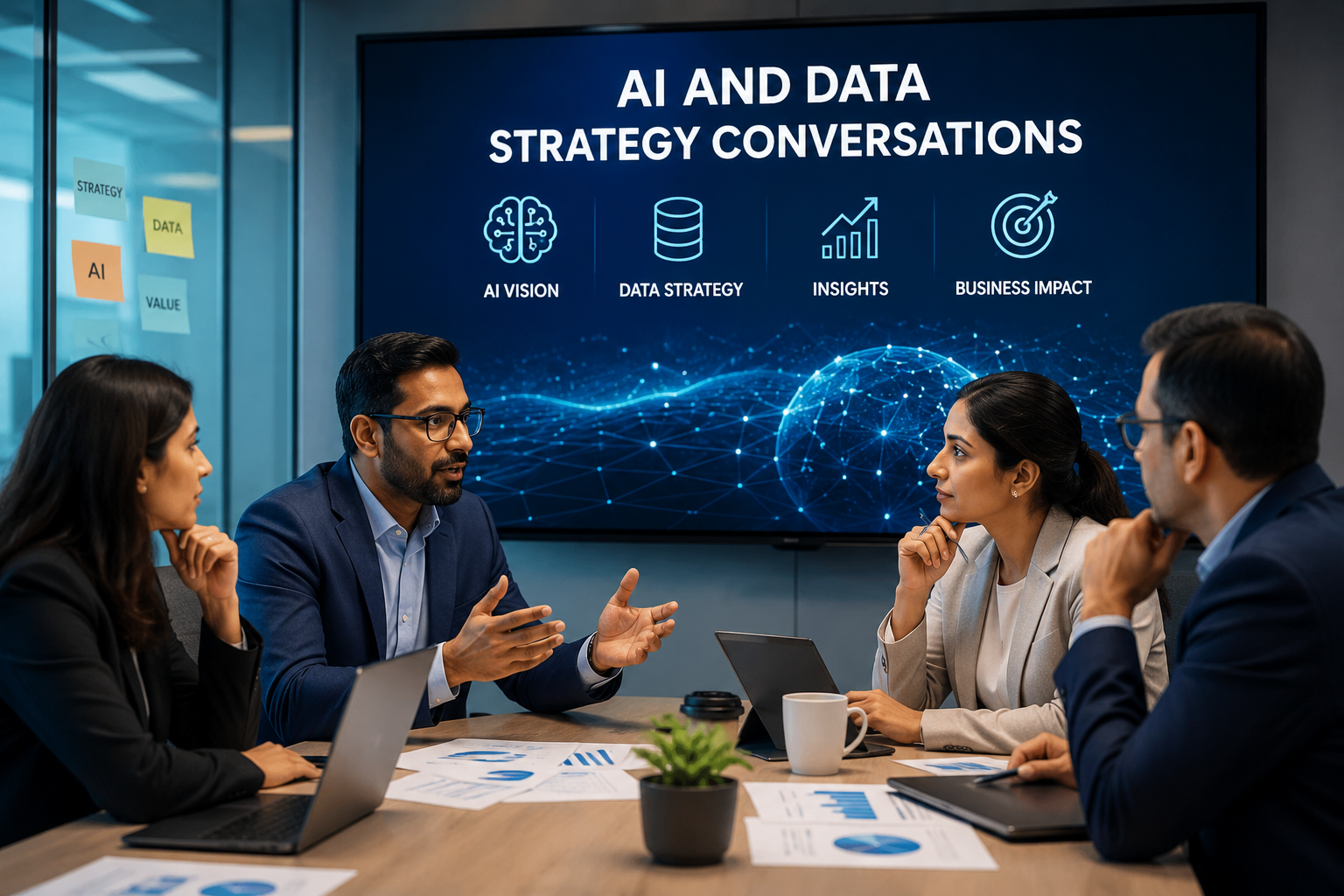
Although most of these organisations have already established IT operations, coupled with experienced Chief Information Officers (CIOs) and technology roadmaps that span years at a time, the notable challenge faced today is inherently structural in nature. Frequent discussions of topics such as AI and data transformation are accompanied by repeat strategy discussions, administration of new assessments, the organisation of new workshops, and periodic reviews of external benchmarks. Despite these measures, herein lies the challenge, one that is implicitly recognised by management: between these rounds of discussions, along the way, momentum may be lost, while evidence of progress seems incremental in nature.
Management Attention Is Spread Across Multiple Priorities
Recent research by McKinsey identifies the fragmentation of the management’s attention across multiple priorities that are often in conflict with each other. In other words, the management may be “spread too thin” across these various priorities, a finding that has merit and basis in reality, as CIOs and technology leaders find themselves responsible for operational stability, cybersecurity, regulatory compliance, cloud cost control, vendor ecosystems, legacy modernisation, and continuous improvements, among others. At the same time, they are expected to lead the wave of innovation for their organisations, maintaining a delicate balance between two of their key responsibilities.
Balancing Operational Stability with Transformation
In terms of the latter role, McKinsey’s research indicated that senior executives often undertake extensive change initiatives, exploratory projects such as AI-driven modifications to operating models, on top of daily operations. As a result, the aforementioned technology leaders might find a significant share of their bandwidth spread between these high-stake responsibilities. Ultimately, this results in delayed decisions that cause its own problems for the organisation, even if they may not be significantly worse than poor decision-making.
From Strategy Discussions to Execution
Our independent consultants are witness to the months invested by organisations into internal research cycles from evaluating AI use cases and preparing business cases, to compiling executive presentations, while their operational leaders must successfully balance their various responsibilities, with each stage contributing valuable insights. However, they also require extended timelines. This, as corroborated by McKinsey, suggests that such initiatives with expedited and more effective progress with respect to execution of strategy comes with well-defined leadership. This begs the question: how can this focus be created without compromising existing leadership structures?
Rethinking Transformation Leadership Capacity
This question compels us to rethink how transformation leadership capacity is applied. McKinsey’s research describes an intentional bifurcation of operational and forward-looking initiatives to ensure neither is compromised. Notably, organisations are pursuing specialised, time-bound expertise to support such initiatives, with each expert acting as an extension of the existing leadership team. Where bandwidth for dedicated transformation leaders is exhausted, the associated responsibilities for handling strategic initiatives may be passed on to line-of-business leaders or cross-functional committees, who carry significant relevant expertise but may not be placed to take on such a full-time role.
The Role of Focused Leadership in AI and Data Transformation
Meanwhile, where AI and data transformation efforts stall as a result of less focus on guided action, the consequence is limited returns. Focused leadership can counteract this, facilitating the conversion rate between mere ambition and successful execution, by bringing in external pattern recognition, informed challenge, and a focus on execution to facilitate progress without compromising on existing structures and processes. This allows CIOs to focus on their fundamental business processes while transformation initiatives operate parallel.
Flexible Leadership Models for Emerging Technologies
With growing acceptance of flexible leadership models when navigating emerging technologies and uncertain transformation paths, each independent technology leader integrates quickly without the weight of the organisational overhead or the internal political climate on their shoulders.
Connecting Organisations with Independent Technology Experts
To that end, IndusGuru connects non-tech organisations with vetted independent domain experts spanning various geographies and industries, providing them timely access, at the moment they require additional leadership support, to an assortment of experienced experts, from AI leaders and data strategists, to architects, among others. Bringing external expertise into the fold within an organisation can thereby help expedite decision-making timelines allowing quicker progress with greater confidence.
Creating a Structural Advantage Through Independent Leadership
It is clear that technology-driven transformation in non-tech organisations tends to lose pace when it is spearheaded by leaders who are spread too thin between multiple priorities. By recognising this constraint early, it is possible to change course! By adapting with independent technological leadership, firms stand to enjoy a structural advantage born from moving quicker between repeated discussions and sustained execution.
The Future of Technology-Driven Transformation
In a world where an organisation’s competitive position increasingly relies on its digital capabilities, the question must shift from whether to transform to how quickly can an organisation create the leadership capacity to effectively execute this transformation.
Connect With Us
If these patterns sound familiar and you are considering your next steps from here, we would love to hear from you! You can reach out to us at [email protected] or visit us at https://indusguru.in.